Living with art
Finding a Sensible Wall for Giraffe in the Loo
Bring the giraffe's dry humour into a guest cloakroom or another suitable indoor space while planning sightlines, moisture exposure, framing and everyday use carefully.
Must Giraffe in the Loo actually hang in a bathroom?
Giraffe in the Loo naturally suggests a bathroom because that is the room depicted. Yet the subject does not require you to hang the print beside plumbing, nor does it make the object suitable for every bathroom condition. Begin with the kind of space you actually have. A dry guest cloakroom used briefly is different from a small room filled with steam after every shower. The artwork can also bring its domestic humour to a hallway, dressing area or another indoor wall if that is the more sensible location. The joke remains understandable outside the exact setting it represents.
Think about who will encounter the picture and when. In a guest cloakroom, it may be a small unexpected discovery. In a family bathroom, it will become part of daily routine. In a hallway, the image may be noticed in passing and understood more slowly. These are different experiences rather than a ranking of good and bad placements. If you want the newspaper detail to be appreciated, choose a position where someone can pause comfortably. If you mainly enjoy the giraffe's unlikely silhouette, a more distant view may still provide the intended touch of humour.
Avoid beginning with the assumption that the room needs a complete animal or safari theme. One amusing picture can be enough. The grayscale palette allows the print to sit among varied colours without requiring matching towels or ornaments. Its specificity is already strong. A room can remain practical and restrained while containing one absurd image. This is often more comfortable than decorating every surface to reinforce the same joke, especially in a small space where mirrors, storage and plumbing already place demands on the available walls.
Find the wall people can see without awkward movement
In a shared household, include the viewpoints of people who use the room differently. A print that appears clear to a tall adult may be partly hidden from a lower viewpoint by a shelf or basin. This does not require engineering a perfect view from every possible position. It simply prevents an installation chosen from one standing spot from becoming inconvenient in daily use. You can make the same check with a temporary outline before any object is purchased or fixed. The giraffe's long shape makes this particularly useful: the animal may be visible while the newspaper detail disappears, changing the way the joke is encountered. A modest adjustment now is easier than moving hardware later, and it can preserve the full little scene rather than only its most obvious silhouette.
Small rooms make sightlines especially important. A wall may look available on a plan but be hidden by an open door, a towel or a person standing at the basin. Walk through the normal sequence of use before choosing the final position. Look from the doorway, from the basin and from any other regular viewpoint. You are not trying to create a staged photograph; you are finding a place where the print can be seen without leaning over fixtures or interrupting circulation. The image's humour works best when the encounter feels natural rather than physically inconvenient.
Mirrors complicate this assessment. A print may be seen directly, reflected, or both. The reflected view can be an enjoyable secondary encounter, but it can also produce clutter when combined with bright fittings and stored objects. Check what the mirror actually captures from different heights. Do not assume that centring the artwork on a bare wall will centre it within the reflection. If the reflected view becomes confusing, a slight shift in position may be more effective than reducing the print size. The room's geometry should guide the arrangement more than a general decorating formula.
Use a temporary outline of the complete finished dimensions. Include the frame if you intend to frame a poster. Then open doors and cupboards, hang the towels where they normally belong and check that the outline remains clear. This practical trial costs little and can prevent an awkward installation. A room visualisation can suggest possibilities, but it cannot account for your towel rail, door swing or storage habits. The right wall is one that supports ordinary use while allowing the giraffe and newspaper to remain visibly part of a coherent image.
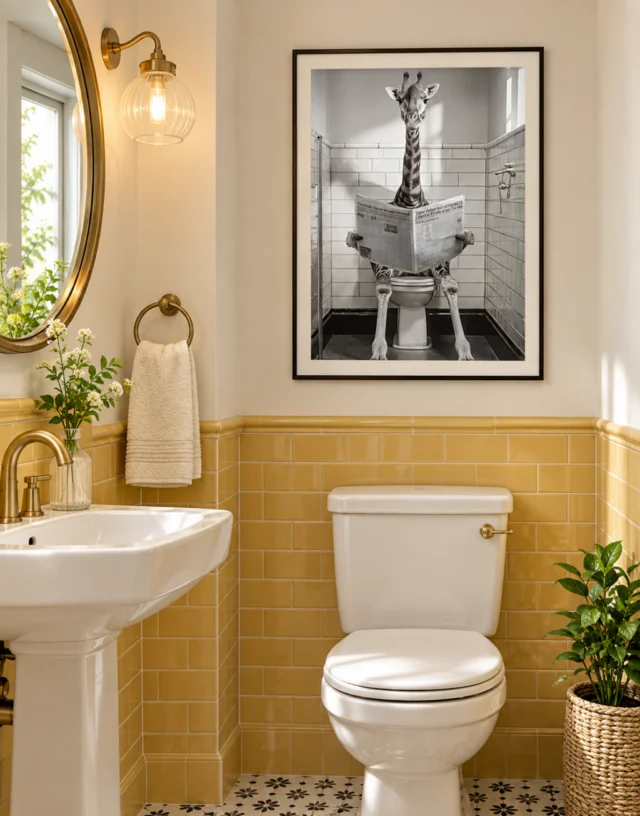
What if the only bathroom wall receives steam or splashes?
The artwork depicts a tiled bathroom, but a print is not a tile. Do not read the scene as a statement of waterproofing or suitability for constant humidity. Before hanging anything in a bathroom, consider the actual exposure at the proposed wall. Can water splash there from the basin or shower? Does condensation remain after the room is used? Is a radiator or other heat source immediately below? These questions concern the object and its environment, not the humour of the image. A visually attractive position may still be a poor practical choice if it creates avoidable exposure.
A framed poster and a canvas presentation need their own appropriate care and display decisions. Framing is not a universal solution to every damp condition, and the absence of a glass surface does not make canvas immune to environmental problems. If the room is persistently humid or the only wall is within a splash zone, choose a different room rather than relying on the product's subject or a room mockup. Seek material-specific advice when needed. The paper-care resource supplied as further reading offers general context for works on paper; it is not a product warranty or a certification of bathroom suitability.
This caution need not make the placement complicated. It simply puts the practical boundary first. Once you have identified a reasonably stable, suitable indoor wall, you can concentrate on scale and humour. A dry cloakroom may offer more freedom than a shower room, but the actual conditions matter more than the room's name. Do not conceal a ventilation or moisture problem behind a decorative decision. The print should be an enjoyable addition to a functioning space, not an experiment in whether an unsuitable environment will damage an object over time.
Use grayscale to simplify, not to drain the room of character
Because the image is grayscale, it can connect with black, white, chrome-coloured fittings and many neutral surfaces without introducing another strong hue. That flexibility does not mean the rest of the room has to become monochrome. A coloured wall or existing towels can coexist with the print. The animal scene already provides enough character to remain noticeable against a simple background. Instead of adding several new black-and-white objects, see whether the picture alone establishes the visual connection you want. This keeps a small room from becoming an overcoordinated display in which every practical item must match.
Look at the contrast between the outer edge of the presentation and the wall. A pale print on a pale wall may benefit from a clearly defined frame, while a dark wall may create enough separation without a strong border. These are possibilities to test, not fixed rules. The actual tonal balance of the artwork and your chosen support will matter. Use a sample frame or a temporary outline where possible. A digital room scene may suggest a combination, but it cannot reproduce the light, colour and surface of the wall in your home with exact reliability.
One colourful element can provide a useful counterpoint if you want a playful room without a full theme. That element might already exist as a painted cabinet or a textile. Avoid buying an object solely because it repeats a feature in a visualisation. The strongest arrangement may come from the room's ordinary materials and the giraffe's unexpected presence. Humour often benefits from a matter-of-fact setting. A clean, functional space with one improbable image can be more distinctive than a room filled with competing novelty objects, each trying to deliver a separate joke.
Size the whole object around fittings and usable space
The giraffe's elongated form makes an upright presentation visually natural, but the available wall still decides what is practical. Measure the space between fixed elements and allow for the finished object, not just the printed image. A poster's frame can add meaningful width and height, especially in a compact cloakroom. Rolled canvas may require later stretching or another appropriate presentation. Stretched canvas has its own external form. Confirm the actual selected dimensions before committing to a position, and do not infer size from a mockup that is designed to suggest an atmosphere rather than document your wall.
Consider the scale of nearby fittings without trying to copy them. A very small print high above a large fixture may feel detached; an oversized piece squeezed between a mirror and a corner may feel accidental. There is no need for a numerical formula to decide the relationship. A full-size paper outline can show whether the object has enough breathing room and whether the giraffe's main shape will be visible from the doorway. Look at the outline with the room in normal use, including towels and stored items. An empty-wall measurement alone can be misleading.
Keep access and safety in the plan. The picture should not obstruct a cupboard, ventilation opening, switch or cleaning route. It should not be positioned where someone is likely to knock it while using a narrow passage. Use fixings suited to the wall and the finished weight, and ask for competent help if you are unsure. A humorous picture does not need a precarious position to make an impression. A secure, well-spaced installation supports the relaxed tone of the image and makes it easier to enjoy without worrying about the practical arrangement around it.
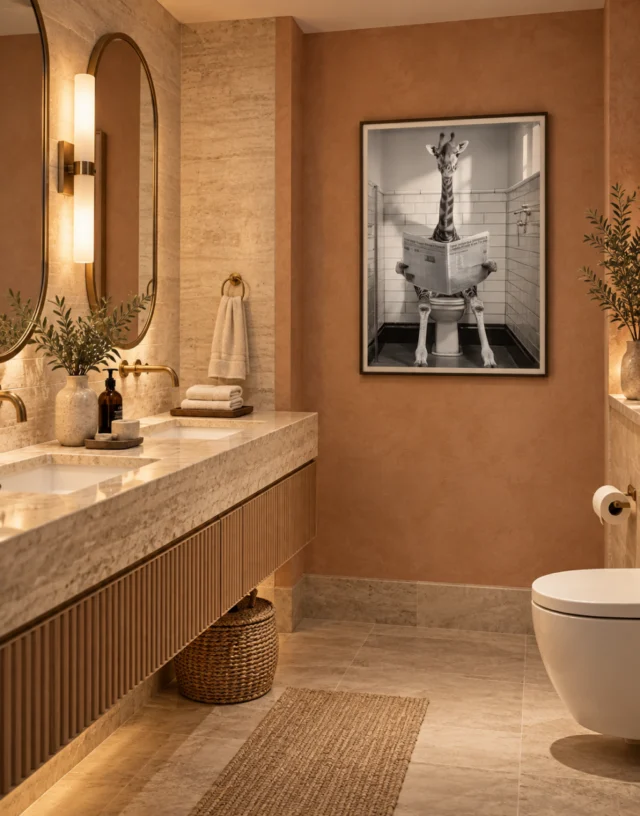
Understand the title, finish and support separately
Hand Finished appears in the product title, but the current configurator remains the authority for the finish on your order. Light selective hand-finishing is optional, not something automatically present because the image has texture or a particular name. Make that choice consciously. The same applies to support: canvas and poster are actual material options, not different descriptions of the joke. The verified canvas is Neptune Natural Matt Canvas 400, a 400 gsm cotton support with a natural warm base and irregular weave. Review the available options and choose the object that fits your installation plan.
The compatible poster papers include Oyster 271 pearl or satin photographic paper and Photo Lustre 310 photographic paper. Posters are supplied rolled and unframed, so leave time and budget for an appropriate presentation if that is your route. You do not need a particular frame colour to make the image work. Consider the room's existing hardware, the need for a clear boundary and the advice of a competent framer. Most importantly, do not mistake a decorative frame for a guarantee against every bathroom exposure. Material and environmental suitability should remain separate from the desired appearance.
For rolled canvas, review the selected image dimensions, printed allowance and final supplied flat dimensions shown with the current configuration. For stretched canvas, distinguish the chosen front face from the stated wrap. Old examples of margins are not universal specifications. These details matter even in a small room because a later presentation can alter the outer size. A clear order review prevents surprises and lets you plan the final wall arrangement using the object you will actually receive, rather than an imagined print size or an assumption derived from the room scene.
Allow the joke to become a small part of daily life
Once installed, the picture does not have to produce a reaction every time someone enters. Its first surprise will become familiarity, and that can be part of its appeal. You may come to enjoy the giraffe's ordinary reading activity as a small recurring absurdity rather than a novelty that needs to be explained. Let visitors notice it in their own time. A humorous image often works better when it is allowed to sit naturally within a room instead of being introduced as a required entertainment. The artwork can be personal and light-hearted without making the space perform a joke continuously.
If the arrangement begins to feel crowded, remove nearby novelty objects before assuming the print itself is the problem. The grayscale scene can carry plenty of personality on its own. If the room's conditions prove unsuitable, move the print to a better location rather than accepting avoidable exposure for the sake of thematic matching. The joke is portable. A hallway or other indoor wall can still make the bathroom scene amusing, perhaps in a different way. Practical care should not be treated as an obstacle to the artwork's meaning; it is part of living responsibly with the chosen object.
The final decision is therefore a combination of welcome humour and sensible placement. Use the product page for exact choices, the Bathroom collection for alternative images and the materials guide for the available supports. Judge your own wall through real use rather than a staged scene. If the giraffe can be seen comfortably, the object is appropriately presented and the conditions are suitable, the arrangement has a sound foundation. It can then remain what it does best: a calm, recognisable interior interrupted by one magnificently unlikely reader.
Check the current print materials guide
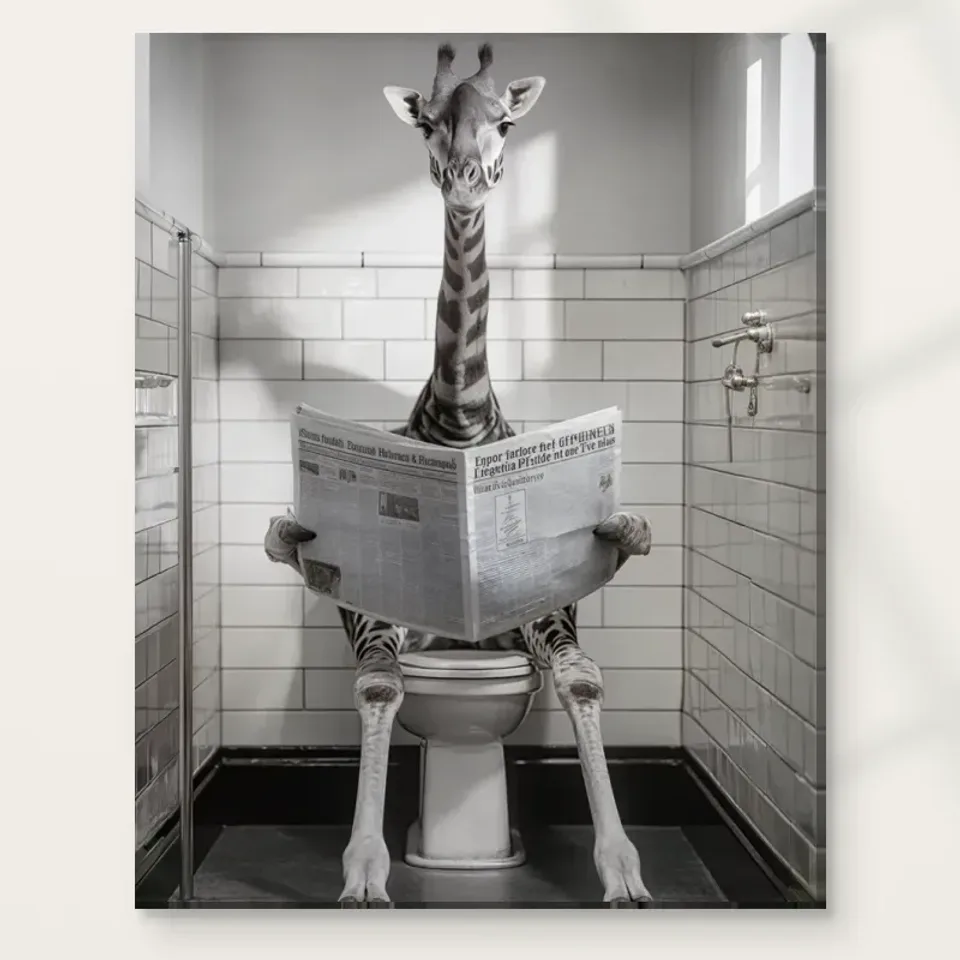
Continue with this artwork
Find your next artwork
Let moisture and size decide the wall
Read more: Let moisture and size decide the wallRead less: Let moisture and size decide the wall
A Giraffe in the Loo wall display carries a dry joke into a real room. A giraffe reads its newspaper in a tiled bathroom, and the scene stays perfectly calm. The humour is gentle, domestic and immediate. However, the room you choose for it decides whether that humour stays welcome.
The five tests here are practical. They cover which room hosts the joke, how sightlines behave in small spaces and how moisture limits placement. They also cover how the object is sized and how light and finish are planned. None of them asks you to dampen the fun. Instead, they protect the print from the one environment its subject merely depicts. A little planning now keeps the joke relaxed and welcoming for years afterwards.
Giraffe in the Loo wall display: the room need not be a bathroom
The depicted setting suggests a bathroom, naturally. The subject does not oblige you to hang the print beside plumbing, though. Nor does it make the object suitable for every bathroom condition. A dry guest cloakroom used briefly differs greatly from a small room full of steam after every shower.
The joke also travels well. A hallway, a dressing area or a downstairs corridor can host the scene just as happily. There, the image becomes a small unexpected discovery rather than a thematic statement. Moreover, a room can stay practical and restrained while containing one absurd picture. You do not need matching towels, safari ornaments or a repeated animal motif. One quiet joke is enough. The grayscale palette helps here, because it asks nothing from the surrounding colours.
Think about who meets the picture and when. In a guest cloakroom it may surprise a visitor. In a family bathroom it becomes part of the daily routine. In a hallway it is noticed in passing and understood more slowly. These are different experiences, not a ranking. Choose the one your household will actually enjoy. If you want the newspaper detail appreciated, pick a wall where someone can pause comfortably. If the tall silhouette alone delights you, a more distant view down the hallway still works.
Giraffe in the Loo wall display: moisture decides before style
A print is not a tile, whatever the image shows. Therefore the practical boundary comes before the decorative one. Look at the proposed wall with honest eyes. Can water splash there from the basin or the shower? Does condensation linger after the room is used? Is a radiator directly below? These questions are about the object and where it lives, not the humour of the image. A charming position can still be a poor practical choice.
If the room stays persistently humid, choose a different room. Framing is not a universal defence, and canvas is not immune because it lacks glass. The Canadian Conservation Institute's guidance on works on paper explains how humidity and handling affect paper objects over time. Treat it as background knowledge rather than a product warranty. The supplier's care notes for your chosen format remain the practical reference.
This caution need not complicate anything. Once you have a reasonably stable indoor wall, you can return to the enjoyable questions. A dry cloakroom offers more freedom than a shower room, but actual conditions matter more than the room's name. The print should be an addition to a functioning space, not an experiment in endurance. Do not hide a ventilation problem behind a decorative decision, either. If condensation is constant, the room needs attention before any artwork does.
Test the doorway, the basin and the mirror
Small rooms make sightlines decisive. A wall can look available on a plan yet vanish behind an open door, a towel or someone standing at the basin. Walk the normal sequence of use before choosing. Check the view from the doorway, the basin and any other regular viewpoint. You are not building a staged photograph; you are choosing somewhere the print stays visible without leaning over fixtures.
Mirrors complicate this further. The print may be seen directly, reflected or both. A reflected view can be a delightful second encounter, or it can become visual clutter among bright fittings. Check what the mirror truly catches from different heights. Never assume that a centred position on a bare wall stays centred in the reflection. If the reflected view confuses, shift the position slightly before you reduce the size.
Giraffe in the Loo wall display: grayscale simplifies the palette
The monochrome image connects easily with black, white and chrome-toned fittings. It also sits calmly among coloured walls and existing towels. That flexibility does not oblige the room to become monochrome, however. The scene already carries enough character to stay noticeable against a simple background. Judge how the outer edge of the presentation reads against the wall surface. A pale print on a pale wall may benefit from a defined frame. A darker wall can create enough separation without one.
Resist adding several new black-and-white objects to reinforce the point. See whether the picture alone establishes the connection you want. As a result, a small room avoids the overcoordinated look in which every practical item must match. One colourful element, such as a painted cabinet or a favourite textile, can provide a lively counterpoint without any theme at all.
Keep novelty objects from competing
Humorous rooms attract humorous objects, and restraint becomes harder there. If the arrangement begins to feel crowded, remove nearby novelty pieces before blaming the print. The grayscale scene carries plenty of personality on its own. A clean, functional space with one improbable image is more distinctive than a room of competing jokes.
Humour benefits from a matter-of-fact setting. The giraffe stays funnier when the room refuses to join in. That restraint also keeps the space flexible, since ordinary objects can change without disturbing the one deliberate absurdity. Visitors can then notice the scene in their own time. A joke introduced as required entertainment rarely survives the introduction.
Giraffe in the Loo wall display: size the whole object
The giraffe's tall form makes an upright presentation feel natural. The available wall still decides what is practical, though. Measure the gaps between fixed elements and allow for the finished object, not merely the printed image. A poster frame adds meaningful width and height in a compact cloakroom. Rolled canvas needs later stretching or another presentation. Stretched canvas carries its own outer dimensions.
Use a temporary outline of the complete finished size. Then open doors and cupboards, hang the towels where they belong and check the outline again. An empty-wall measurement alone can mislead. The National Gallery's frame glossary is a useful reminder that a border changes both size and presence. Plan around the object you will actually receive rather than an imagined print. Consider the scale of nearby fittings without copying them. A tiny print floating high above a large basin feels detached. An oversized piece squeezed beside a mirror feels accidental.
Keep access and safety inside the plan as well. The picture should not obstruct a cupboard, a switch or a cleaning route. Nor should it hang where someone will knock it in a narrow passage. Choose fixings matched to the wall and to the finished weight. Ask for competent help if you are unsure about either. A humorous picture needs no precarious position to make its impression. A secure, well-spaced installation supports the relaxed tone of the scene.
Giraffe in the Loo wall display: confirm the finish before hanging
The title includes Hand Finished, yet the configurator remains the authority for your order. The optional finish is light and selective where offered, and no title wording makes the print hand made wall art by default. Make that choice consciously, the same way you choose the support. Neptune Natural Matt Canvas 400 is the stated cotton canvas at 400 gsm. The compatible poster papers are Oyster 271 and Photo Lustre 310. Posters arrive rolled and unframed, so allow time and budget for a suitable presentation on that route. Rolled and stretched canvas follow their own stated dimensions, and a frame adds its own outer size.
When you buy wall art for a small room, sequence matters. Measure first, then order. If you buy artwork only after the outline has survived a week of normal use, the product-page evidence guide keeps the stated facts separate from the staged scenes. The print materials guide then answers the support questions in plain terms.
Wall art in a bathroom-adjacent space earns its keep quietly. Artwork of this kind works best when everything around it stays ordinary. For alternatives in the same setting, the bathroom artwork selection offers comparison. For the image itself, the Giraffe in the Loo composition guide studies what the picture does.
Frequently asked questions
Which five tests does a Giraffe in the Loo wall display use?
Which room hosts the joke, how sightlines behave, how moisture limits placement, how the object is sized and how light and finish are planned. Run all five before drilling anything.
Is a Giraffe in the Loo wall display only for bathrooms?
No. The depicted setting suggests one, but the joke travels well. A hallway, cloakroom or dressing area can host it just as happily, often with kinder conditions.
Is the print waterproof because it shows a bathroom?
No. The image depicts tiles; the object is a print. Humidity and splashes affect it like any other artwork. Choose the wall by actual exposure rather than by theme. A dry cloakroom beats a steamy shower room every time.
How do mirrors affect placement?
They create a second, reflected encounter. Check what the mirror captures from different heights, and shift the position if the reflection turns cluttered rather than charming.
Does Hand Finished mean the print is hand made wall art?
No. The optional finish is light and selective where offered. The order controls, not the title, determine what arrives.
Will the grayscale palette make the room feel cold?
Not on its own. The image adds no new hue, so existing colours remain in charge. One colourful object can provide warmth while the print supplies the character. Chrome-toned fittings and white tiles already suit it well.
What size works in a small cloakroom?
Measure the finished object, frame included, against the wall between fixed fittings. A temporary outline tested during normal use tells you more than any formula.
Can I add other funny animal prints nearby?
You can, though restraint serves better. Several novelty pieces compete with each other. One improbable reader usually entertains more than a crowded menagerie.
What if the only free wall gets steamy?
Choose another room. Persistent humidity is a reason to relocate the plan, not to test the print's endurance. The joke survives the move intact.
How should the giraffe relate to nearby fittings?
Give it breathing room rather than copying their scale. A small print floating high above a large fixture feels detached. An oversized one squeezed beside a mirror feels accidental.
Are the room scenes on the page real installations?
No. They are visualisations that suggest possibilities. Your measurements, your door swing and your towels determine the real arrangement.
What is the final check before I order?
Confirm the support, the finished dimensions, the presentation and any optional finish. Then stand in the room once more and make sure the quiet joke still lands from where you will actually see it.
Conclusion: keep the room ordinary and the giraffe extraordinary
A Giraffe in the Loo wall display succeeds when everything around it stays calm. Choose the room by conditions, not by theme. Test the sightlines, respect the moisture and size the whole object. Then see Giraffe in the Loo on its product page , then weigh the stated support, dimensions and finish against the wall you have chosen.