
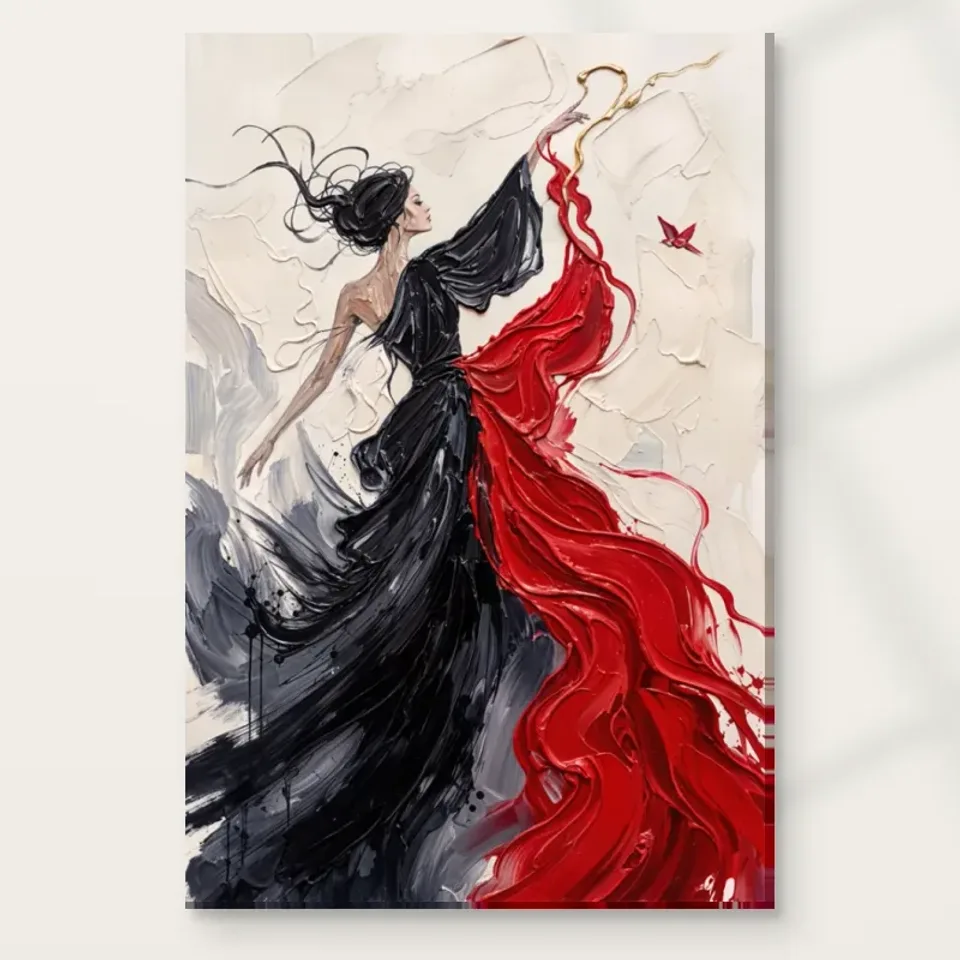


Artwork Graceful Figure in Red and Black Expressionist
From £23.00
30.48 × 45.72 cm · Rolled canvas
View artworkThe Golden Ads collection
Find a piece that feels like you.
53 artworksCanvas & rolled poster
Selected from the collection
From £23.00
30.48 × 45.72 cm · Rolled canvas
View artwork

From £23.00
30.48 × 45.72 cm · Rolled canvas
View artwork


From £23.00
30.48 × 45.72 cm · Rolled canvas
View artwork

Another way to look
Begin with a style you love, or a room waiting for something of its own.
Golden Ads is a Manchester studio and online shop where you can buy wall art UK-wide. Start with a picture you want to see every day. Then decide how you would like it presented: as a rolled poster, rolled canvas or stretched canvas, depending on the piece.
A search for “buy wall art UK” leaves many people comparing formats before they have compared pictures. This guide reverses that order: it explains what to measure, what to look for in the gallery and what the studio’s optional hand-finishing means.
Think about where your eye should go when you enter the room. A strong face can draw attention directly to one place. A broad landscape may pull your gaze along a wall instead.
Notice which parts of your shortlisted wall art prints still make sense when you step back. A finely detailed scene might reward a longer look beside a chair. However, big shapes and a clear light-dark contrast often read more easily from a doorway.
The National Gallery’s explanation of composition offers a useful starting point for looking. Follow one line through a picture and see where it sends your eye. In a room with lots of sharp lines already, a loose composition may offer a welcome change of pace.
Next, use the wall art collection to shortlist two pictures with different moods. Imagine seeing each against the same wall after a long day. That simple comparison often tells you more than matching a cushion to a colour in the image.
Choose a rolled poster if you want the printed image on paper and expect to arrange its presentation yourself. It comes unframed. Before ordering, decide whether you will use an existing frame or select one later.
Rolled canvas arrives unstretched. It can suit someone who already has a framer or wants to choose the final mounting locally. However, allow for the work needed after delivery when you compare its cost with a stretched option.
Stretched canvas is supplied ready to hang where the product offers that option and you select it. The canvas sits on a stretcher rather than inside an outer decorative frame. Check what your wall requires before choosing fixings; ready to hang does not mean one fixing suits every wall.
Households that buy wall art in the UK often meet these three formats for the first time on the same product page. If you prefer the surface of canvas, use the canvas wall art range to find designs and see the presentation choices on their product pages. Compare the same artwork and visible size where possible. Otherwise you may be comparing two different images or sizes when you meant to compare two finishes.
Use a tape measure for the usable width. Stop at the edge of furniture, a door swing or a light switch if it limits the space. The full width of the wall is seldom the only number that matters.
Next, make a paper outline of the size you are considering. Put it on the wall if you can without marking the surface. Examine it from the place where you actually sit or stand.
A portrait shape can make a narrow wall useful without occupying its whole width. Conversely, landscape wall art can connect the width of a sideboard with the space above it. Neither orientation has to fill the available area.
Read the dimensions beside your chosen option. The visible artwork and the supplied size of a rolled canvas can differ because of the printed margin. If a frame or a stretcher must fit, use the figure that describes the part you need to fit.
For a living room, start at the sofa and look towards the proposed wall. Decide whether the picture should lead the room or sit comfortably alongside other objects. People who buy UK wall art for a shared room often test a shortlist with someone else first. Explore these living room wall art selections if you want a first group to compare.
In a bedroom, try standing in the doorway and then looking from your usual place in the room. Wall art prints that feel calm at one distance might feel busy at another. So choose the view that matters most to you, not just the position that looks best on a photograph.
In a narrow entrance, people often see the wall at an angle before looking straight at it. Look for a shape that remains readable on approach. Leave clearance for coats, bags and the movement of doors.
For a reception or shared space, agree on what the space needs first, such as a calmer arrival or a memorable focal point.
Brush-like marks in a gallery image can belong to the design that the studio prints. They do not, by themselves, tell you what someone has added by hand to the physical print. Look at the selected finish rather than inferring it from a photograph.
Golden Ads offers professional hand-finishing as a separate option for eligible canvas prints. The studio’s explanation of professional hand-finishing sets out what that choice means. If a product offers it, review the selected finish and price before adding the artwork to your basket.
The difference matters when you compare wall art prints for close viewing. You might care more about the image’s colour from across the room than about its surface up close. Conversely, the physical finish might matter more for a piece you will regularly pass at arm’s length.
Do not treat hand-finishing and stretching as alternatives. One concerns work applied to the printed surface. The other concerns how you receive and display the canvas.
Use the front-facing view to judge the image itself, then look at the room views for ideas about placement. A room image does not give you a reliable measurement of the furniture or the supplied print. Compare your chosen dimensions with the actual space.
Likewise, use the gallery to see how the picture’s colours sit together rather than to predict an exact match to your paint. Compare the gallery on the same screen if you shortlist two pieces. Then look at the proposed wall in daylight and under its evening lights.
The guide to checking a wall art product page explains how to distinguish the image, the print format and the details of the option you choose. Check those three things before comparing prices. A headline price may describe a different presentation from the one you want.
Finally, pick the quantity you need and read the selection back before proceeding. If you plan to buy artwork for different rooms, check each selection on its own. A familiar title does not mean you chose the same size or finish twice.
Notice where direct sunlight falls on the wall during the day. A spot that looks softly lit in the morning can receive strong light later. If the room offers two convincing positions, choose the one with less direct sun.
The Canadian Conservation Institute’s guidance on displaying paintings explains why light and heat matter for artworks. Its discussion is general conservation guidance, not a lifespan claim for our wall art prints. For material-specific questions, start with the information shown for the item you choose.
Also consider how you use the area around your wall art prints. A print beside a frequently opened cupboard may face more knocks than one on an open wall. If the location makes cleaning or handling awkward, use a different spot rather than squeezing the artwork in.
The products described here are prints, not original paintings sold as one-off objects. A printed image can show the appearance of painted marks. Separately, an eligible canvas may offer a finish that the studio applies by hand; check the options on the product page.
A standard print is not an entirely handmade piece. If you select professional hand-finishing where offered, the studio works on the canvas after printing. Therefore, describe that selection as a hand-finished print rather than assuming the whole work was painted by hand.
Yes, guest checkout is available for anyone who wants to buy wall art UK wide. First choose the product options and add the item to your basket. Then provide the requested delivery and payment details; you do not need to register for a separate customer account to place an order.
Start with the visible artwork dimensions for the option you want. If you plan to mount or frame a rolled canvas, check the separately listed supplied dimensions as well. They answer different questions: what you will see and what material you will receive.
Use the options shown on the specific artwork page. Do not assume a presentation exists for one print just because another design offers it. When you shortlist two prints, first check that both have the size and presentation you actually intend to compare.
Canvas and poster paper are different print surfaces. Both can arrive rolled, but that word only tells you how they are supplied. Think about how you intend to mount the print, then check the surface and dimensions before choosing between the two.
Do not assume so. Stretched canvas describes the canvas on its supporting stretcher. Look for an explicitly stated outer frame if that feature matters to you, or choose the print with a plan to discuss the final presentation with your own framer.
Use the room pictures for decorative ideas, not scale. A sofa or bed in an image does not set the dimensions of your print. Read the numbers for your selected size and check those dimensions against your own furniture and wall.
Compare them at the same proposed visible size if you can. Notice which picture you pick out first and which holds your attention longer. Then consider whether that response suits the room’s use, including the distance and light at which you will usually see it.
Find out how the recipient wants to display it before choosing the format. A rolled print leaves the final presentation open. However, a stretched option, where offered, removes a separate stretching step if the recipient already has a suitable wall in mind.
No. Think about the viewing distance and which qualities you want to notice. In a shared room with a longer viewing distance, the composition might matter more to you. At close range, you may want to ask how the optional finish changes the physical surface.
Pick the desired size, material, presentation, finish and quantity on the artwork page. Read the amount for that selection rather than relying on the first amount you see in a grid. Check the basket as well, especially if you order more than one piece.
Choose the image first. Then settle on a size and presentation that work in the room, and check whether optional finishing adds something you will appreciate. If you are ready to buy artwork, return to your shortlist and open the product you would most like to live with.
Give yourself one last look from the place where you will normally see it. If the picture still feels right from there, you have a better reason to choose it than any preset rule about style, size or colour.